Turning feelings into data for better retrospectives
We bring people into a room, we ask questions like what went well and what needs to change, and then we expect that conversation to somehow surface the real issues in the system. We rely on people remembering what happened over the last sprint, we rely on them feeling comfortable enough to speak up, and we rely on our facilitation skills to guide the conversation in the right direction.
That’s a lot of reliance on very human variables.
Because the reality is, people don’t always say what they truly think. Not because they don’t care, but because they’ve forgotten the details, or they don’t want to come across as negative, or they don’t feel safe calling something out in front of others. And very often, the tone of the conversation is shaped early on by whoever speaks first or loudest.
So what we end up working with is not a clear view of reality. It’s a filtered version of it.
And then we wonder why the same issues keep coming back sprint after sprint.
At the same time, something else is happening every single day.
Frustration shows up in a Slack message when something is blocked again.
Confusion shows up in a Jira comment when priorities keep changing.
Energy shows up in fast, constructive back-and-forth when things are flowing well.
These signals are constant. They are unfiltered. And they are far closer to reality than anything we capture in a one-hour retrospective.
We just don’t use them.
What Are Sentiment Signals?
When I talk about sentiment signals, I’m not talking about asking people how they feel or sending out another survey.
I’m talking about observing patterns in how people communicate while they are actually doing the work, and using AI to make those patterns visible.
Every interaction carries a tone. On its own, that doesn’t tell you much. But when you start looking at it over time, across teams, and across different areas of the organisation, it becomes something far more useful.
It becomes a signal.
A signal that shows you where work is flowing and where it is not.
A signal that highlights tension before it turns into delivery problems.
A signal that gives you a more honest view of the system than what you will get from a single conversation in a retrospective.
That is what sentiment signals are — not opinions collected in a moment, but data-based patterns that reflect how work is actually being experienced over time.
The Shift: From Asking to Observing
What I’ve been experimenting with recently is a different way of approaching this entirely.
Instead of relying only on what people say in a retrospective, what if we start looking at how people actually communicate while they are doing the work? Not in a facilitated session, but in their day-to-day interactions — in Slack messages, in Jira comments, in the conversations that happen when things are real and immediate.
That’s where you start to see patterns that don’t always make it into a retrospective.
This is where the idea of sentiment signals becomes powerful. It’s not about asking people to label their emotions. It’s about observing how sentiment shows up naturally in their communication over time, and turning that into something we can actually work with.
What This Looks Like in Practice
What I’ve been working on is a way to make those signals visible.
Instead of relying only on what people say in a session, we can start looking at how sentiment evolves over time based on real interactions. That gives us something far more grounded to work with — not perfect data, but directional insight that reflects what is actually happening in the system.
Here’s an example of what that can look like in practice:
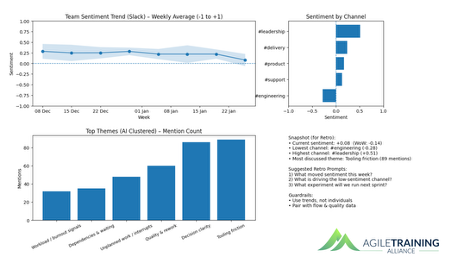
What you’re seeing is not “perfect data” — and that’s not the point. It’s directional. It shows patterns over time that are very hard to spot when you rely only on conversations in a room.
At the top left, you can see the overall sentiment trend. In this case, it’s relatively stable, but there’s a slight dip towards the end. On its own, that doesn’t tell you much, but it tells you something has shifted, and that’s where the conversation starts.
On the right, you get a breakdown by channel. This is where it gets interesting. Leadership is clearly sitting on the positive side, while engineering is the only area trending negative. That gap is often where your real problems sit — not in one team, but in the disconnect between them. The data often shows me that either leadership is happy or the engineers are happy — not often both at the same time. Makes you wonder what’s really going on in the system 😉
At the bottom, you see the themes pulled from actual conversations. Things like tooling friction, decision clarity, and rework are not coming from a workshop — they are coming from how people are talking while doing the work. That gives you a much more honest starting point.
Finally, the snapshot on the side pulls it together into something you can actually use in a retrospective. Where is sentiment lowest? What changed this week? What is the most discussed problem?
Why This Matters for Scrum Masters and Agile Coaches
When you walk into a conversation with this kind of view, the dynamic shifts. You are no longer trying to extract feelings from the room — you are responding to patterns that are already there.
And that changes the quality of everything that follows. When themes like tooling friction or dependencies show up repeatedly, you can finally connect the feeling to an underlying cause.
The conversation becomes less about collecting opinions and more about understanding patterns.
One of the biggest shifts I believe we need in our industry is moving away from seeing our role as facilitators of meetings, and back to what we are actually accountable for, which is effectiveness.
The challenge is that you cannot improve what you cannot clearly see.
Traditional retrospectives give you a snapshot, influenced by memory and context. Sentiment signals give you a trend, influenced by real behaviour over time. That is a fundamentally different level of insight.
It also removes some of the pressure from the retrospective itself. Instead of trying to “pull” the truth out of the room, you are bringing the system into the room with you. The data does not replace the conversation, but it grounds it in something more objective and harder to ignore.
If you want to take this further, the next step is learning how to use AI in a way that actually adds value to your role.
Our AI for Scrum Masters course is designed to help you do exactly that — turning ideas like sentiment signals into practical capabilities you can apply in your teams.